
I give a lot of thought and writing time to “worthiness.”
So many of us feel unworthy at times.
While it’s painful to feel that we are unworthy, it’s downright dangerous to believe that we are unworthy.
On the other hand, it’s empowering–and healing–to recognize ourselves and one another as worthy. Worthiness builds respect and opens us to reverence. Worthiness leads us to good things, to great things.
I just saw some valuable messages about worthiness in the film, Oz.
In case you don’t already know, this 2013 Disney movie, the back story of The Wizard of Oz, shows how the Wizard got to the Land of Oz long before Dorothy arrives.
As the story begins, we meet Oscar Diggs, a small time magician in a traveling circus in Kansas. While Oscar loves a lot of things about his work, appreciates wonderment, and has big dreams, mostly he judges himself as unworthy.
Steeped in the art of illusion, Oscar perceives himself to be less than honorable. He comes across that way too, as cunning, crafty, and shrewd. As viewers, we question his integrity, just as he does of himself.
Like Dorothy, Oscar is carried to Oz by a tornado. There, he appears to be the foretold Wizard who will defeat the Wicked Witch and restore peace and harmony in the Land of Oz.
Accepting the call to act as Wizard brings Oscar through many conflicts and trials with the three witches and within himself. Often, he doubts his ability to do any good at all. In fact, he begins to see himself as even less worthy, a really big fake, because he is pretending to be a Wizard with truly special powers.
It takes the Good Witch, Glinda, to reflect to him, again and again, what she sees in him: a man doing his best, a man with a caring heart, a man with limitations and flaws, yes, but a man with goodness at the core, a man who is worthy.
At last, at the end of the movie, Oscar sees himself as worthy. He commits to trying his best to restore peace and harmony to the Land of Oz. He becomes the Wizard.
May we all see worthiness in ourselves and one another, do our best to bring peace and harmony to our world, and become what we are called to be.
“When I was a boy and I would see scary things in the news, my mother would say to me, ‘Looks for the helpers. You will always find people who are helping.’ “ - Fred Rogers
Mindful of hope, let’s look for the helpers. Mindful of beauty, let’s be the helpers. Mindful of wisdom, let’s nurture others with this perspective.
With love and gratitude for my mom and all moms, Happy Mother’s Day!
When I catch myself starting to judge, and I wish, instead, to simply accept all the differences among us, I recall a family trip to Italy.
Upon arriving in Multepulciano, we visited the Duomo.
“Aw, cute doggie,” gushed Stephanie, pausing on the steps outside the door.
“Look! A della Robbia!” squealed Many Lou upon entering and glancing to the left.
Frank was drawn straight to the tomb.
The worn wooden kneeler in front of the confessional most interested me. While each member of our family explored according to his or her own interests, with my own knees pressed into the grooves formed over centuries, I thought of the hurts carried in the hearts of thousands of people who had knelt there before me.
Krista stood, took all that in, and, with delight, shared what she saw: Stephanie loving animals, Mary Lou loving art, Frank loving history, me loving stories.
The fact is: we all see the world differently.
Instead of trying to convince others to see things our way or judge others for having different points of view and interests, we can appreciate the rich diversity among us and follow the callings of our own hearts.
All with reverence.
Thank you, Stephanie, for sharing this photo of a tree growing in the gutter.
the strength that is in us,
the strength that is life,
the beauty that is in us,
the beauty that is life,
the courage that is in us,
the courage that is life,
the hope that is in us,
the hope that is life,
the gifts that are in us,
the gift that is life.
“Forget not that the earth delights to feel your bare feet,
and the winds long to play with your hair,” wrote Kahlil Gibran.
May we delight in nature’s wonders and respond to earth’s caring for us with reciprocal loving.
“Everything on the earth has a purpose, every disease an herb to cure it and every person a mission,” said Mourning Dove Salish
Consider the wondrous web of which we are a part. When we bring our gifts and talents forward, we help heal, renew, and strengthen the whole.
“The ground on which we stand is sacred ground,” Chief Plenty Coups reminds us.
May we greet every day as a Reverence for Earth Day.
After walking the labyrinth and circling the perimeter around St. John Vianney Church in Sedona, I crossed Soldier Pass Road to hike on the Sunrise Trail.
My thoughts were of Lucky, a relative who had recently died. Lucky loved Sedona, especially the grounds of that church. Thoughts of Lucky led me to reflect on all my family members and friends who had passed from this world.
I was still thinking of the deceased when I started on the Sunrise Trail. Shortly into the walk, I noticed a sign with the name “Gregg” and “the Buckthorn Family.”
Although I had not known him, I wondered about Gregg and the Buckthorn family that had placed this commemorative marker on the trail. Perhaps Gregg was a man who showed deep reverence for nature.
My thoughts moved in a new direction as my gazed lifted beyond the close-at-hand scenery out to the wide Red Rock vista while I walked on.
After a few more steps, my focus came back to the sights along the trail. I noticed another marker. This one said “The Cashew Family.”
I laughed out loud when I realized that the bronze plates I had seen were not to honor people who had died; they were there to identify plants along the trail!
It’s funny, sometimes, how our existing thought patterns can lead us to false conclusions.
The truth is that we all engage in error thinking quite often. And it is usually not funny.
Besides coming to wrong conclusions, as I had on the Sunrise Trail, we all hold limiting and false beliefs about ourselves and the world.
For example, we might belief that we have to be perfect in order to be valuable and lovable. We might believe that others must see things our way and admit that we are “right.” We might believe it is a sign of weakness to say, “I don’t know.”
What can we do about error thinking?
We can be willing to see from other perspectives. We can be willing to see shades of grey instead of just black and white. We can notice when we assume what others are feeling. We can stop comparing ourselves with others. If we find ourselves thinking that we, or others, are not “good enough,” we can let go of negative judgments.
Even though error thinking is usually not funny, we can look for some humor in it. Whether or not we chuckle, we can always practice compassion, expand our thinking, and appreciate more of life’s panorama.
“You’re nuts.” Has anyone ever told you that?
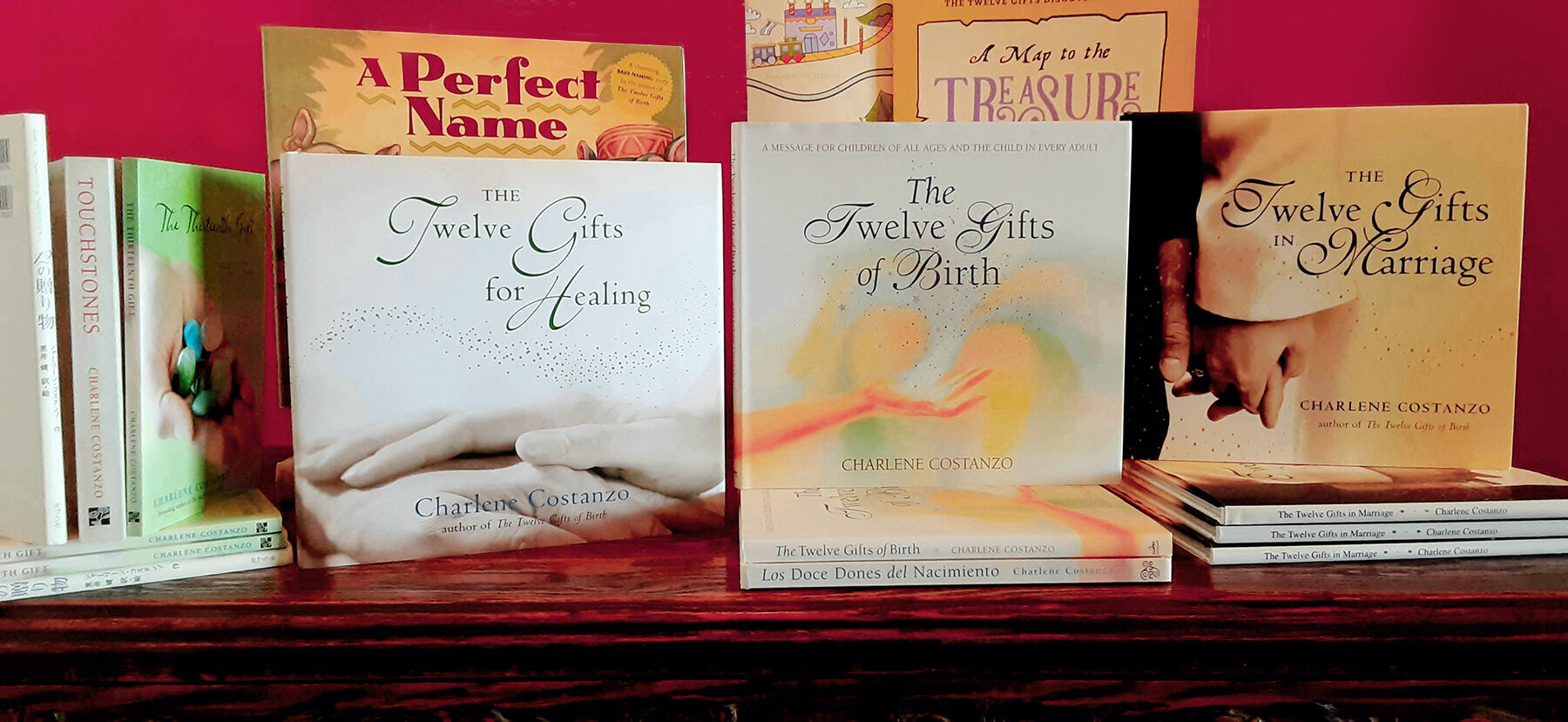
That’s what a bookbinder said when I described my vision for producing The Twelve Gifts of Birth book. After listening to how I wanted to bring my manuscript into the world with full-color illustrations, high-quality paper, a hard cover, and a die-cut that would offer a “peak-through” from one page to the next, he first said nothing. He just fanned through the pages of my primitive, hand-made “mock-up” and shook his head.
“You’re nuts, lady,” he then said. “There is no way you can do this. Your book will have to retail for at least, oh $40. Maybe $45. And no one is going to pay that much for this little gift book!”
The business owner went on to advise me to cut back on the features I wanted and to scale back my vision, way back.
“You might want to… not produce this book at all,” he said. “It’s pretty simple, not much text here. I hate to discourage you, but I think this project might be a waste of money.”
I could hardly leave the premises fast enough. And yet I could barely walk, due to the way my knees were shaking. My hands were shaking too. My whole body was trembling, in fact, with shock, hurt, fear, disappointment, confusion.
Just as I got into my car and pulled the door shut, the light sprinkling of rain I had driven through on the way to that meeting burst into a heavy downpour. While rivulets of water streamed down the front window and around my car, tears flowed down my cheeks. Not trusting myself to drive with poor visibility due to the conditions both outside and inside my car, I sat in the parking lot and waited for the storm to pass.
Am I nuts? I thought. I questioned the feasibility of my dream and my visions for it. And, as I did, the “weather” within me matched the weather outside, dark and dreary.
And then, out of the blue, an image of a humble, yellow building appeared in my mind. I recognized it as one of the laboratories where Thomas Edison had conducted experiments. The historic structure was not far from my childhood home in New Jersey. During my teen years, I had driven by it many times. It always seemed to call for my attention. Often, when I passed it, I wondered about the actual day-to-day work that had been done there. What discoveries had been made? What failed attempts had happened there? What disappointments and frustrations had been experienced?
And, with the image of that little lab in mind, I wondered how many people had said “Your nuts!” to Thomas Edison in some shape or form.
I reminded myself that my meeting with the bookbinder was simply an exploratory step on my publishing journey. I did not yet know the exact steps I needed to take to make my dream a reality. However, I felt certain that small steps would eventually bring me to my goal, even if some of those steps seemed to be missteps. Clearly, having my books bound at that business was not going to be part of my publishing plan. That was actually a good thing to know. That was a gain I had made that day.
The best gain, however, was being filled again with courage, even more courage than I had previously felt. I resolved that day, even if I heard again and again that I was “nuts” or “unrealistic,” I would continue to take steps toward my dream. With renewed and deepened courage, I felt certain I would reach my goal, just as Thomas Edison eventually found the right filament to create the electric light bulb.
Fifteen years after my exploratory visit with that bookbinder, The Twelve Gifts of Birth and subsequent series is approaching one million books beautifully made, reasonably priced, and sold successfully. It turns out: there was a way. The idea was do-able.
How are you feeling about your dream? Have you ever gotten to the point where it looks impossible?
Consider what Thomas Edison said: “Nearly every person who develops an idea works at it up to the point where it seems impossible, and then gets discouraged. That’s not the place to become discouraged.”
He also said, “If we all did the things we are capable of, we would astound ourselves.” And, “When you have exhausted all possibilities, remember this – you haven’t.”
Might Thomas Edison–his example and his words–be a courage touchstone for you too?
Blessings for all your dreams. May you be deeply en-couraged!
“It is hard to tell our bad luck from our good luck sometimes.”
– Merle Shain
Situations that first seem “bad” can turn out to be “good” in some way. By the same token, sometimes situations that seem positive may turn out to give us challenges.
One of my touchstones for hope and faith is a Chinese story that offers wisdom about this:
Long ago there was a farmer who lost his favorite horse. Besides helping the farmer with his work, the mare was like a friend. One day she wandered away. The old man searched but couldn’t find her. His neighbors went out to look too. When the horse could not be found, the neighbors tried to console the farmer. “We are sorry that this bad fortune happened to you,” they said.
The farmer smiled and replied, “Thank you for helping me search for my horse and for your condolences, but we shall see. Bad fortune? Who knows? Things are always changing.”
A few weeks later the horse returned. With her walked a strong stallion.
“Good fortune!” said the neighbors.
“The farmer again said, “We shall see.”
In time the mare gave birth to a foal. “Good fortune!” said the neighbors.
The farmer simply smiled.
A few months later, the man’s son broke his leg while trying to ride the untamed young horse.
“Oh, bad fortune!” said the neighbors.
“We shall see,” said the farmer.
The son’s leg soon began to heal.
“Good fortune,” said the neighbors.
The farmer smiled.
In time the son walked again but with a slight limp.
“Oh, too bad. Bad fortune,” said the neighbors.
“We shall see,” said the farmer, smiling, of course.
A year later a terrible war began. Most young men were called to serve. Many never returned. Because the farmer’s son walked with a limp, he was considered unfit to be a soldier. He stayed on the farm and survived to live a long life.
May we trust what is unfolding.